
Property Record
1703 W HOPKINS ST
Architecture and History Inventory
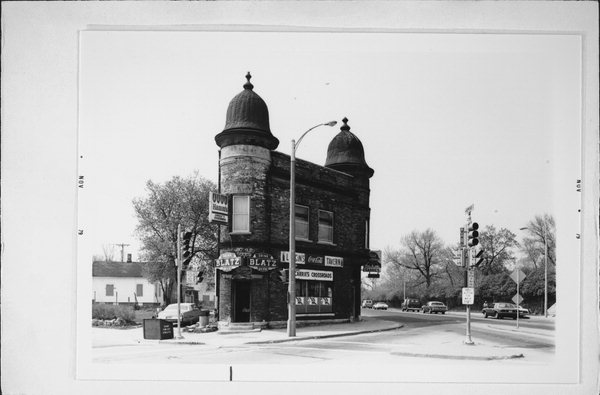
| Historic Name: | SCHLITZ BREWING COMPANY SALOON |
|---|---|
| Other Name: | WILSON'S CROSSROADS BAR |
| Contributing: | |
| Reference Number: | 31744 |
| Location (Address): | 1703 W HOPKINS ST |
|---|---|
| County: | Milwaukee |
| City: | Milwaukee |
| Township/Village: | |
| Unincorporated Community: | |
| Town: | |
| Range: | |
| Direction: | |
| Section: | |
| Quarter Section: | |
| Quarter/Quarter Section: |
| Year Built: | 1894 |
|---|---|
| Additions: | |
| Survey Date: | 1980 |
| Historic Use: | tavern/bar |
| Architectural Style: | German Renaissance Revival |
| Structural System: | |
| Wall Material: | Cream Brick |
| Architect: | Charles Kirchhoff, Jr. |
| Other Buildings On Site: | |
| Demolished?: | No |
| Demolished Date: |
| National/State Register Listing Name: | Not listed |
|---|---|
| National Register Listing Date: | |
| State Register Listing Date: |
| Additional Information: | "The German ethnic character of this former brewery-owned corner "saloon" is embodied primarily in its eye-catching helmet-like domes that are topped with spiky finials. In Germany, the architectural history of the helmet-shaped, domed roof can be traced back to at least the 16th century. Helmet roofs were then called "Italian bonnets" or, in German, "welche hauben" because they were said to have been inspired by early Italian Renaissance style domes. In Germany today, helmet-shaped domed roofs can still be seen atop the towers of many old manor houses and castles. It was no accident that the architects for the Schlitz Brewing Company chose this quintessentially German feature to call attention to their saloon and evoke associations between Old World brewing traditions and their client's beer. The metal-clad domed roofs that top this building are fine examples of the advanced skills possessed by Milwaukee's carpenters during the late 19th century. Craftsmanship such as this is difficult to duplicate today and very important to preserve. The walls of the building are made of Milwaukee's celebrated "cream brick" which was prized for its soft golden yellow hue. Cream colored brick is unique to the Milwaukee area and some of it was exported as far away as Germany for the ornamentation of buildings. In the late 19th century, it was a common practice for large American brewers such as Schlitz, to build or purchase their own saloons and restaurants and then rent them to tenant managers, who, in turn, would promise to sell only the owner's beer. Schlitz was one of the pioneers among America's big 19th century brewers in acquiring or building taverns and restaurants in order to promote the sale of its German-recipe beers. By the early 1890s, Schlitz already owned more than 50 taverns and restaurants in the Milwaukee area. The brewery-owned saloons were typically very well constructed and often located on street corners where there was plenty of traffic. They usually ranked among the most architecturally outstanding structures in their neighborhoods. The first manager of this tavern was Albert Renske was lived in the shopkeeper's flat above the saloon. The Prohibition Act of 1919 closed the doors for good on many saloons, while others continued in business as "soft drink parlors" where non-alcoholic beverages were served. This former tavern, however, was converted to retail use and was rented to the North Side Auto Trimming Co. in 1920. By the late 1920s, the building was vacant, but in 1934, one year after the Prohibition Act was repealed and alcohol could again be served legally, Gustave J. Klawitter reopened it as a tavern. It is still used as a tavern today." MILWAUKEE ETHNIC COMMERCIAL AND PUBLIC BUILDINGS TOUR, CITY OF MILWAUKEE DEPARTMENT OF CITY DEVELOPMENT, 9/1994. |
|---|---|
| Bibliographic References: | MILWAUKEE ETHNIC COMMERCIAL AND PUBLIC BUILDINGS TOUR, CITY OF MILWAUKEE DEPARTMENT OF CITY DEVELOPMENT, SEPTEMBER 1994. Tax program |
| Wisconsin Architecture and History Inventory, State Historic Preservation Office, Wisconsin Historical Society, Madison, Wisconsin |