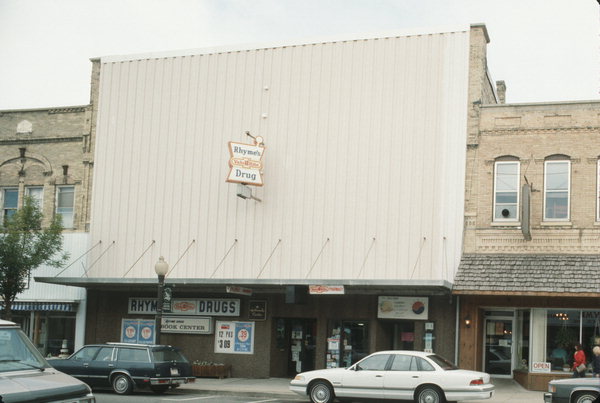
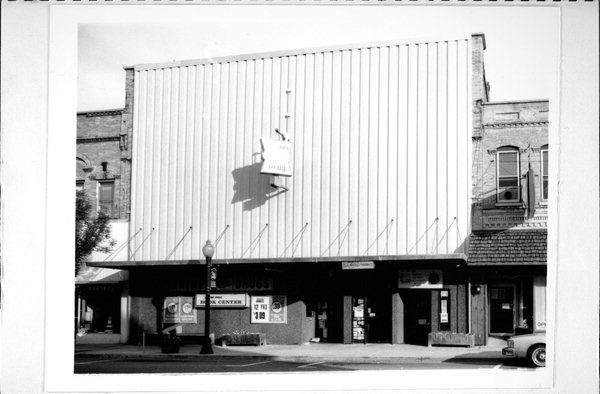
| Additional Information: | The facade of the cream brick building is covered with aluminum and pebble dash.Dave Eulberg (1993) identified the building as Montgomery Wards prior to its ownership by Rhyme's Drug Co. It was Eulberg's Opera House before World War II when the brewery company owned the building. It was originally built as Dullaghan's Opera House.
Many of the concerts and others entertainment occurred at the Portage or Eulberg Opera House at 115-117 E. Cook. John Dullaghan, a private businessman, erected to two story, cream brick building in 1879. Originally, it displayed a relatively eleborate, commercial Italianate style. Samuel Stotzer carved the marble name and date stone under the center gable. A wide, central stairway led to the second floor opera hall placed above a double retail space. The hall sat 350 guests, the stage measured 29 by 51 feet with an orchestra pit placed before it, and it included four, rather small dressing rooms. John Dullaghan managed and owned the Portage Opera House until 1886 when Hadfield Company purchased the building and Alexander Carnegie replaced him as the manager. Carnegie continued to arrange programming and John Thompson maintained the Opera House until about 1920. The Eulberg Brewing Company acquired the building about 1915 after its ownership by A.W. Stark beginning in 1901. It then also became known as the Empire Theater. After Carnegie, Julius Eulberg served as the manager and booking agent of the Eulberg Opera House or Empire Theater.
Dullaghan opened his opera house with a grand ball presented by the Guppy Guards on September 15, 1879. Located on the main Chicago, Milwaukee, and St. Paul Railroad line, portage had ample access to traveling performances. Performances booked at the opera house included musical performances frequently advertised the preceding noon by parades along Cook Street. Stock companies accompanied by their own bands remained up to a week performing a different repertoire each evening. Professional performances included melodrama, musicals, slapstick comedy, minstrel shows, travel lectures, fashion shows by local clothing shops, Shakesperian tragedies, plays such as "Uncle Tom's Cabin," "The Farmer's Daughter" or "Remember the Maine," and ion later years movies. Local, amateur drama groups and organizations also presented home talent shows. About 1913 after Zona Gale wrote "The Neighbors," a drama teacher at the high school produced the play with local talent at the Opera House. Voluntary associations frequently presented fund raising performances. The Liederkranz Singing Society presented benefit concerts. High school graduation occurred in the Opera House before the construction of the 1917 high school;. An orchestra was made available for each show when not provided by the outside companies. The Opera House closed in 1929 as movies rose in popularity. The building was then remodeled on both the exterior and interior to house Montgomery Wards. This business occupied the store through 1955 (Portage Daily Register 1960 [3/7: 8/4-8]; 1967 [2/18/1/1-7, 3/4-5]; 2/7/1970; 7/10/71; Butterfield 1880: 654, Voshardt 1910: 22; Mohr 1952).
The two retail spaces in the first floor changed their functions relatively frequently. Frank B. Ernsberger established a mercantile store known as Ernsberger & Co. in the Opera House in 1879 for one year before moving to Cambria (Butterfield 1880: 663, 896; Democrat 7/30/97). By 1908-09, the Opera House Bar operated in the building; and a saloon probably remained below the opera house from 1885 until at least 1929. John Dullaghan opened a crockery shop in one retail area during at least 1884-1885. Although one side b ecame vacant in 1889, by 1894, a millinery shop had located in one retail space. By 1901 through 1910, business located in one of the retail spaces between at least 1918 and 1929 when Montgomery Wards occupied the building. |
|---|
| Bibliographic References: | Sanborn-Perris Map Co.
1929: double store: 115: auto repair and 117: saloon
1918: opera house above, 115: saloon, 117: auto sales.
1910: opera house above, both section below a saloon.
1901: Portage Opera House above and saloon below.
1894: Portage Opera Housae above and 115: saloon and 117: millinery below.
1889: Portage Opera House above and 115: vacant and 117: saloon and billiards.
1885: Dullaghan's Opera House above and 115: produce and 117: saloon and billiards.
Columbia Co. Treasurer 1863
1870-1878: Gates And Austin
1879-86: John Dullaghan
1887-1900: Hadfield Co.
1901-1912/15: A. W. Stark
1912/15-1929: Eulberg Brewing Company
1930: H. A. Gunderson
The value of the property rose in 1879. The opera house replaced an earlier building.
Directories:
1955: (117) Montgomery Ward and Co. (Johnson Printing Co.)
1948: (117) same (Commonwealth Telephone Co.)
1937: Montgomery Ward & Co., E. Cook Street (Commonwealth Telephone Co.)
1929: (115-17) vacant (Smith-Baumann Directory Co.)
1917-18: (115-17) Empire Theater (Farrell)
1911-12: Belong and Miller, saloon (R.L. Polk & Co.)
1910: (117) (John) Belong and (Fred) Miller, saloon (Voshardt)
1908-09: (115) Opera House Bar (S.H. Moore)
1897-98: Opera House, A. H. Carnegie Manager
1886: Dullaghan, John Sr. Prop. of Opera House (R.L. Polk & Co.)
1884-85, 1885: Dullaghan, John, crockery and prop. of Opera House, seats 850 (R. L. Polk & Co.)
Historic Portage, WI: Downtown & Waterfront Walking Tour, 1995. |
|---|