| Additional Information: | A 'site file' exists for this property. It contains additional information such as correspondence, newspaper clippings, or historical information. It is a public record and may be viewed in person at the State Historical Society, Division of Historic Preservation.
Park Hall was built by other members and the William Dresen, Sr. family. This is the only active Free Thought Congregations remaining in the country. The Freie Gemeinde was founded in 1852-1853 by political and philosophical refugees from Germany and German-speaking countries.
The Freie Gemeinde von Sauk County, or Free Congregation of Sauk County, is one of the largest and most enduring of the Union of Free German Congregations, an influential group of humanists who emigrated from present-day Germany in the 1840s and 1850s. Eduard Schroeter, the national leader of the movement, served the Sauk City congregation as speaker from 1853 until his death in 1887. The Freethinkers eschewed designation as a religious denomination but nonetheless organized as a congregation to meet their collective needs. In their incorporation papers, they pledged themselves to the intellectual and moral independence of men and women and issued a ringing proclamation of anticlericalism. Here in the Freethinkers’ Hall, German culture--its language, literature, music, and food--flourished in public lectures, concerts, and celebrations, and thus the building helped to maintain a close-knit community. In 1937, the congregation adopted English as its language, and today it is affiliated with the Unitarian Fellowship.
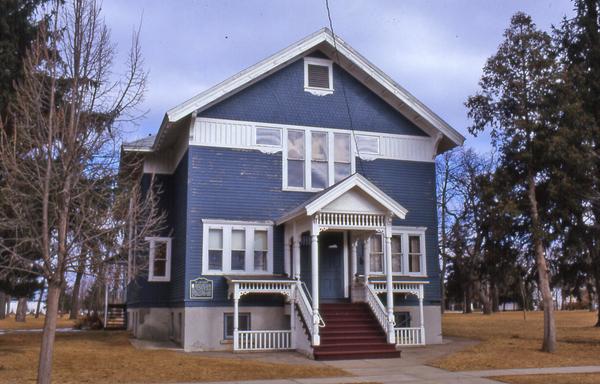
Most Folk Victorian buildings were designed by builders, but the plan for the Freethinkers' Hall was drawn by Alfred Clas, at a cost of $3,300, who was son of one of the congregation’s founders and one of the best-known architects in the state. He designed a front-gabled, clapboard building with a symmetrical plan. Though plain, the design incorporates well-chosen details: the fishscale shingles in the roof and dormer gables and a vertically paneled frieze, interrupted at the center of the facade by a trio of tall windows. About 1918, the original shed-roof porch was replaced by a more elaborate one with turned columns, spindle friezes and balustrades, and scroll-sawn cut brackets.
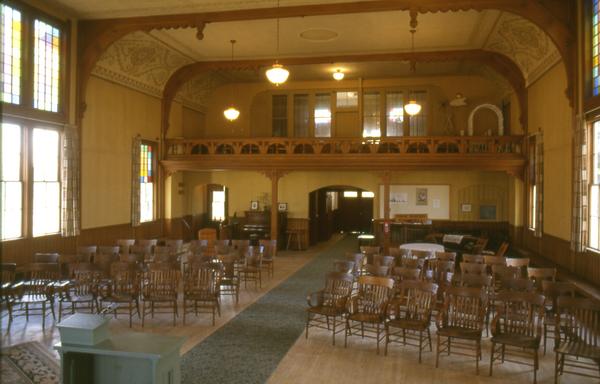
Inside, the main hall is ornate yet restrained. The two-story space has a coved ceiling, made more dramatic by an elaborate floral pattern stenciled in tan, rose, and blue, colors that are repeated in the stained glass in the top sash of the windows and in the ceiling panels. Spanning the south end of the hall, one of the arched wooden ceiling ribs frames an elevated gallery.
Conrad Schmitt Studios oversaw the restoration of the interior from 2020 to 2022. |
|---|