

Draper Manuscripts Collection
Take a Closer Look
At Draper Manuscripts!
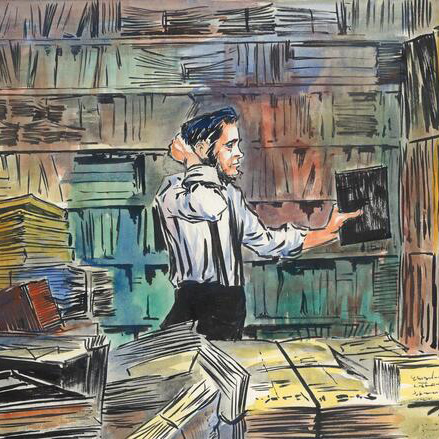
Lyman Copeland Draper (1815-1891) was the first corresponding secretary for the State Historical Society of Wisconsin. Interested in the history of the early United States, Draper made it his life's work to collect materials on the topic and spent years doing research to write a book. Draper's research manuscript collection was bequeathed to the Wisconsin Historical Society after his death.
Finding Aid Search Digitized ManuscriptsSixth plate ferrotype/tintype portrait of Lyman Draper (1815-1891), an American historical collector and librarian. ID:W012754
Draper Manuscripts Collection
Valuable collection of Trans-Allegheny history
The Draper Manuscripts collection primarily covers the period between the French and Indian War and the War of 1812 (ca. 1755-1815). The geographic concentration is on what Draper and his contemporaries called the "Trans-Allegheny West," which included the western Carolinas and Virginia, some portions of Georgia and Alabama, the Ohio River valley, and parts of the Mississippi River valley.
Draper's research focused on military engagements, conflicts between groups on the western frontier, and westward exploration, such as the Lewis and Clark Expedition. Strengths of the Draper Manuscripts include records and information on the Revolutionary War and the War of 1812, especially those actions which occurred in the Trans-Allegheny West.
Features of the Collection
- Correspondence
- Interview notes
- Extracts from newspapers and other published sources
- Transcripts of official documents
- and much more

Draper manuscripts collection
How Is The Collection Organized?
The Draper Manuscripts Collection is organized into 491 volumes, divided into 50 series. Each series is titled by a geographic area, by a subject, or by the name of a prominent frontier leader and is assigned a letter for reference, from A- ZZ. Citations are listed in the format of Volume-Series-Page. For example, 18CC15 refers to Volume 18 of the Kentucky Papers (CC), page 15.
Collection Finding AidThere is no comprehensive index to the entire Draper Manuscripts Collection. However, there are several ways to locate information within the collection, all available at the Society.
- Guide to the Draper Manuscripts: The "Guide to the Draper Manuscripts" by Josephine Harper includes a summary of each series and an index of key names, events, and locations listed in the collection, as well as a Revolutionary War pension applicant index.
- Calendar guides: More detailed than Harper's Guide, the calendars give abstracts of each series, as well as an index of key names and locations with complete citations, including page numbers. There are calendars for only nine series.
- Documentaries: Five documentary volumes, which compile documents extracted from the Draper Collection and formed into narratives of the events they documented.
- Indexes: Several published indexes for specific series exist. Draper created his own indexes in several of the series as well.
- Descriptive List: The Descriptive List of Manuscript Collections of the State Historical Society of Wisconsin, edited by Reuben G. Thwaites and published in 1906, served as the sole finding aid for the majority of the fifty series until the creation of Harper’s Guide. Unlike the Guide, the names are listed in appearance order rather than alphabetically, but there are inaccuracies throughout.
Accessing the Collection
The Draper Manuscripts Collection is organized into 491 volumes, divided into 50 series. Each series is titled by a geographic area, by a subject, or by the name of a prominent frontier leader and is assigned a letter for reference, from A- ZZ. Citations are listed in the format of Volume-Series-Page. For example, 18CC15 refers to Volume 18 of the Kentucky Papers (CC), page 15.
Series Finding AidsThe original physical papers can be viewed at the Wisconsin Historical Society Archives. Photographs or scans cannot be taken of the original documents.
Microfilm: The entire collection was microfilmed in 1949 and re-filmed in the 1970s. The Society holds sets of microfilm to view in the Library; we will also send individual reels through InterLibrary Loan.
More than ninety libraries across the country also have complete or partial sets of the microfilm. See the list of other libraries that have the Draper Collection on microfilm.
Collections Use FAQs
Explore how you can find, access, and use our collection materials.
The Society's library and archives collections can be searched in the University of Wisconsin-Madison Library catalog and some parts of our collections have been digitized and are available online.
The Society's historical object collection cannot be searched online.
Library & Archives
Many books, bound periodicals, microforms and government publications may be checked out for home use with a library card. Rare, fragile, small and heavily used materials (including genealogical resources) do not circulate. A borrowing card is not required if you want to use materials within the Library. Archival materials are available for use in our Archives Reading Room.
For more information about our borrowing policies Library & Archives Services.
Historic Objects
If you are interested in viewing our historical objects please contact us.
Due to significant demands associated with developing the Wisconsin History Center, the Society has reduced capacity to handle loan requests. Therefore, we are not accepting new requests at this time.
For a credit line: Wisconsin Historical Society, Creator, Title, Unique Identifier.
The Unique Identifier can be found at the top or bottom of the webpage for each item. The name of a downloaded file is NOT the unique identifier.
For bibliographic citations please consult the UW-Madison Libraries Citation Research Guide to ensure compliance with appropriate style guidelines.
Personal use (prints, gifts, home and study): Request images for personal use
Commercial use (public display, publishing, media, products, film and more): Request commercial use of our Collection
Materials in our websites and digital collection are provided for research, teaching, and private study. The Wisconsin Historical Society hold rights to some items; others may be governed by additional copyright or donor restrictions.
We encourage users to download low-res images from our website for personal or classroom use, without written permission, within the meaning of the principles of “Fair Use.”
Permission is required for reproduction, publication, or commercial use of any content made available through our websites and digital collection. By using this website, including our digital collections, you agree to the Terms of Use. Users are responsible for determining whether their intended use qualifies as fair use under U.S. copyright law. When relying on fair use, cite the source.
Visit Our
Library & Archives
Perhaps the best way to begin exploring our collections is by visiting us in person. In our reading rooms, you’ll find free and unparalleled access to our collections, helpful staff and amenities, and perhaps, your very own story.
Plan Your Visit Hours

Donate to The Society's Collections
Your Story is Wisconsin's Story
History is made every day, everywhere. Since 1846, contributions from people across the state have helped us fulfill our mission to collect, preserve and tell the stories of Wisconsin.
Find Out HowLast Updated: October 23, 2026


