Dr. Amy Rosebrough
State Archaeologist for the Wisconsin Historical Society


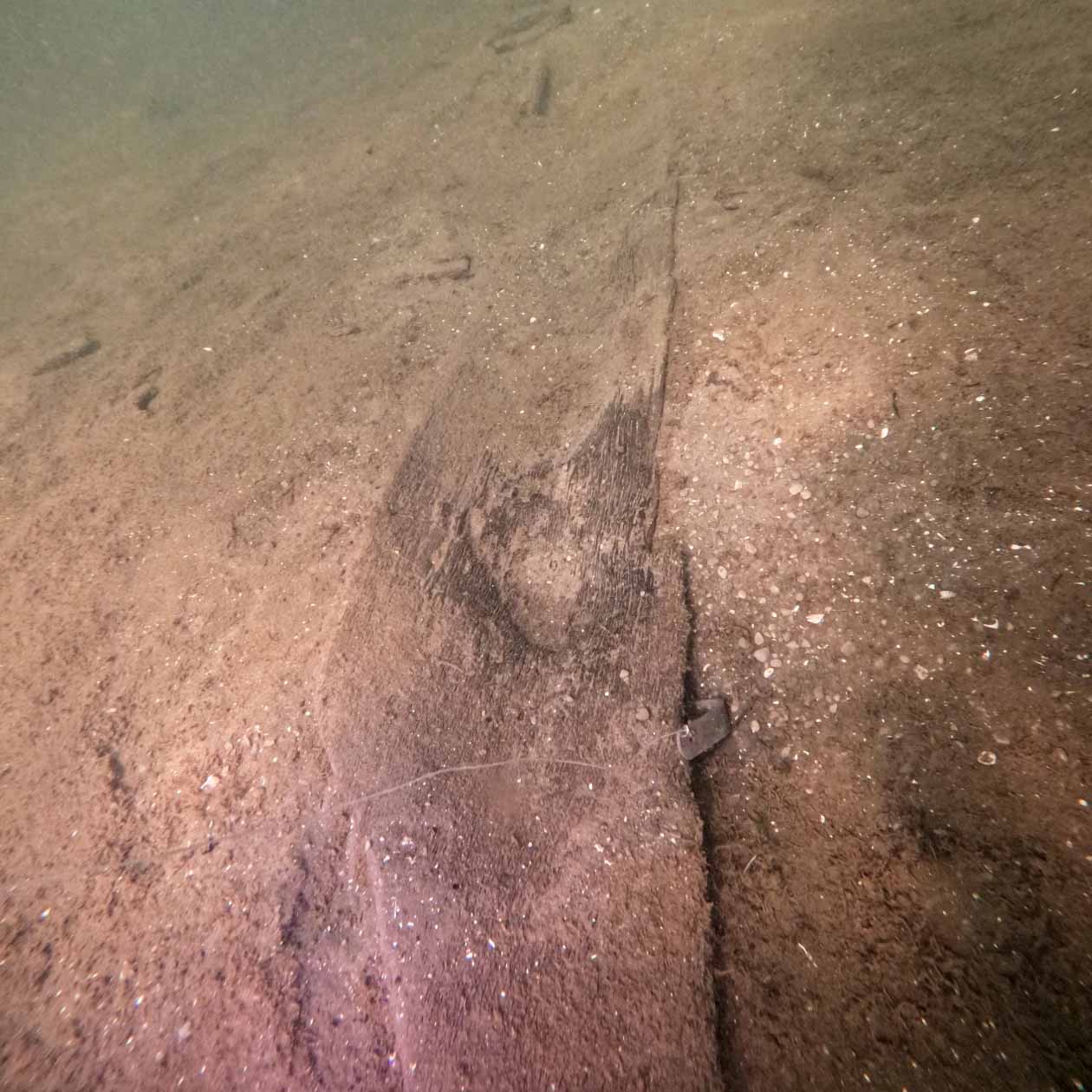
The Wisconsin Historical Society, in partnership with First Nations in Wisconsin, recovered a pair of ancient dugout canoes from Madison’s Lake Mendota (Tee Waksikhominak in the Ho-Chunk language) in 2021 and 2022. Carbon dating revealed the first canoe is 1,200 years old (800 A.D.) and the second 3,000 years old (1000 B.C.).
The recoveries drew international attention and since that time, Wisconsin Historical Society archaeologists and First Nations in the region have continued to wade into the history of the rich archaeological site in the heart of Wisconsin’s capitol city.
The oldest of the 16 Lake Mendota dugout canoes now identified was likely crafted sometime around 3000 BCE—before the Great Pyramid of Giza was built in Egypt—making it the oldest dugout canoe recorded from the Great Lakes region.
As the two recovered canoes are nearing completion of a multi-year preservation process, with one of them slated for exhibition in the future Wisconsin History Center, historians continue to investigate the history behind the underwater site to help preserve and share the story with future generations.

What we thought at first was an isolated discovery in Lake Mendota has evolved into a significant archaeological site with much to tell us about the people who lived and thrived in this area over thousands of years and also provides new evidence for major environmental shifts over time.


The 15-foot dugout canoe was recovered from Lake Mendota on Nov. 2, 2021. Dated to 800 A.D., it is the oldest fully intact vessel ever to be extracted from Wisconsin waters. It was also the first canoe found with artifacts on board – net sinkers used for fishing. News of the recovery spread on social media and has made headlines.

The 14.5-foot dugout canoe was recovered from Lake Mendota on Sept. 22, 2022. Dated to 1000 B.C., it was previously the oldest canoe ever found in the Great Lakes region. It was unearthed within 100 yards of the 1,200-year-old canoe, prompting research into ancient shorelines and fluctuating water levels.
Every person that harvested and constructed this caašgegu (white oak) into a canoe put a piece of themselves into it. By preserving this canoe, we are honoring those that came before us.
The two recovered canoes are undergoing a multi-year preservation process that uses Polyethylene Glycol (PEG) to stabilize the wood, followed by a freeze-drying process to strengthen and solidify the vessels. The preserved Lake Mendota canoes and the stories of their makers will be shared in the Wisconsin History Center, and through other educational programming across the state.
The canoes give us insight into a sophisticated travel network and interconnected communities who used their incredible skills and knowledge to live and thrive on lands where we still live and thrive today. They reflect a deep relationship with the environment and the ingenuity of our ancestors
A group of Ho-Chunk youth and tribal members visited the State Archive Preservation Facility in Madison to view the 1,200-year-old canoe in its preservation tank. The group arrived via the Yahara River, paddling a new dugout canoe that they had carved from a cottonwood tree. The visit was part of a five-day paddling journey of the Four Lakes region that is so significant to Ho-Chunk history and culture.


We are excited to learn all we can from this site using the technology and tools available to us, and to continue to share the enduring stories and ingenuity of our ancestors.


We are working alongside Native Nations to protect a piece of history for future generations. We are excited about the possibilities the canoes offer to help share Native American stories and culture through the present day.


Help the Wisconsin Historical Society preserve and share the stories of these significant cultural artifacts.
Donate Today
The Wisconsin Historical Society would like to thank the many partners who helped in the recovery, preservation and ongoing research of these pieces of history. A special thank you to leaders of the Ho-Chunk, Bad River Ojibwe, and other Native Nations, whose support and partnership throughout this effort have been invaluable. We are also grateful to the Dane County Sheriff’s Department dive team and other volunteers who lent their expertise and equipment essential to the successful recovery of the canoes.
State and federal laws protect this location. Divers may not remove artifacts, objects or structures when visiting this site. Removing, defacing, displacing, or destroying artifacts or sites is a crime.
Wisconsin State Archaeologist, Dr. James Skibo, led the team that worked in close coordination with the Native Nations on the historic recovery of these canoes in 2021 and 2022. Skibo passed away on April 14, 2023, while on a routine work-up dive preparing for the maritime archaeology season. We were honored to have him join the Wisconsin Historical Society in 2021 and grateful for his leadership on this effort and many others.